Into the Depths: Some Pioneers of Early Deep-Sea Exploration

Long before today’s high-tech submersibles roamed the ocean floor with robotic arms and HD cameras, a handful of intrepid explorers risked their lives to pierce the darkness of the deep. In an era when much of the underwater world remained shrouded in mystery, these men not only defied technological limits but also expanded humanity’s understanding of the ocean’s most hidden realms.
William Beebe and the Bathysphere
In the early 1930s, American naturalist William Beebe—already well-known for his wildlife expeditions—set his sights on the last great frontier: the deep ocean. Partnering with engineer Otis Barton, Beebe used a spherical steel vessel called the Bathysphere, a hollow orb barely big enough for two men, with only small quartz windows to peer into the abyss.
Suspended by a steel cable from a ship off the coast of Bermuda, the Bathysphere was lowered deeper than any human had ventured before. In 1934, Beebe descended to 923 meters (3,028 feet)—a record at the time. Peering out into the blackness, he reported sightings of creatures never before seen, from glowing jellyfish to bizarre, dragon-like fish. While his descriptions sparked debate—especially of animals no one else has documented—Beebe’s work captured the public imagination and laid the foundation for deep-sea biology.
The Trieste and the Challenger Deep
Fast-forward to 1960. The Cold War was in full swing, technology was advancing at breakneck speed, and the race to explore the most extreme environments had moved from space… to the deepest part of the ocean.
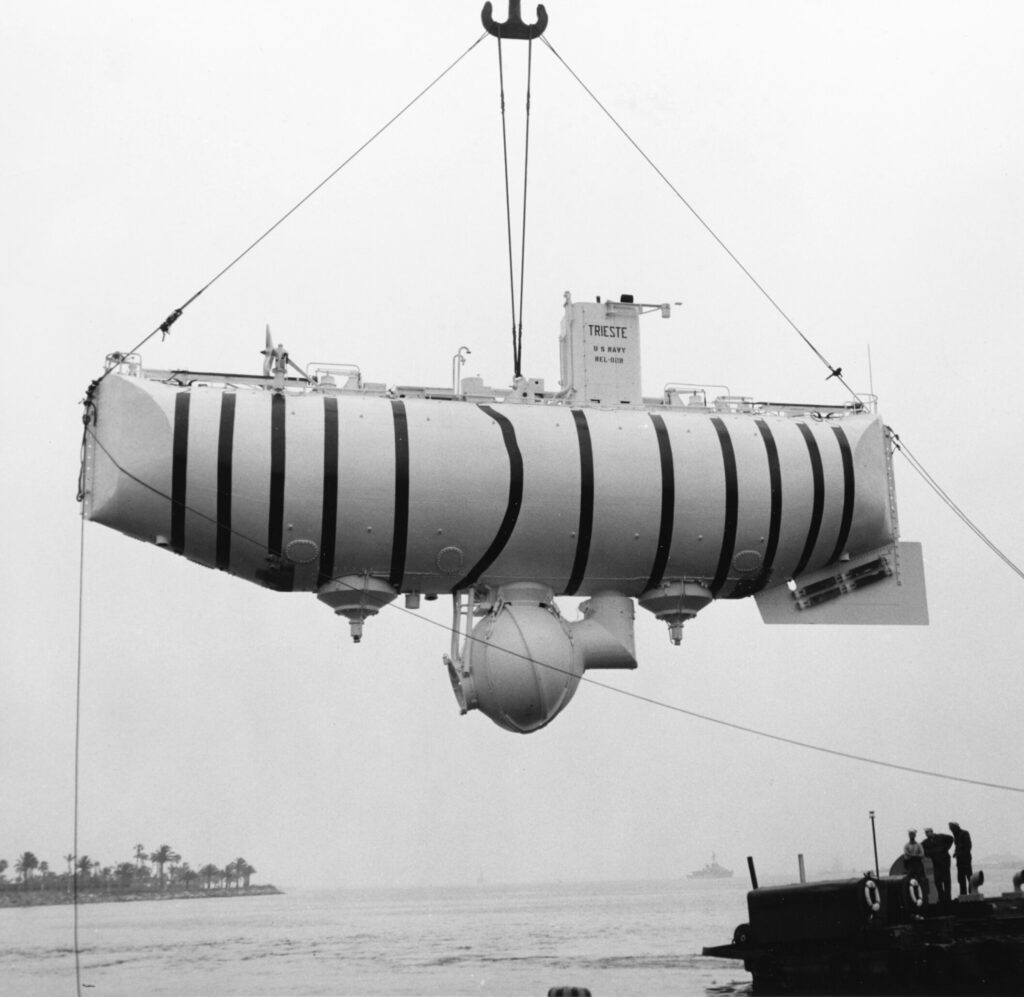
The Bathyscaphe Trieste, designed by Swiss engineer Auguste Piccard and refined by his son Jacques Piccard, was a marvel of engineering—a submersible designed to withstand the crushing pressure of the Mariana Trench, the deepest known point in Earth’s oceans. In January 1960, Jacques Piccard, together with U.S. Navy Lieutenant Don Walsh, began their historic descent.
Over nearly five hours, the Trieste sank through the midnight zone into the hadal depths, finally touching down at 10,911 meters (35,797 feet) in the Challenger Deep. The view? A flat, silty seafloor, disturbed only by the movement of a small, flatfish-like creature. The pair spent about 20 minutes on the bottom before beginning their long ascent back to the surface. Their dive remained unmatched for over half a century.
A Legacy Beneath the Waves
Beebe, Walsh, and Piccard came from different backgrounds and eras, yet they shared a relentless curiosity and courage that pushed the limits of human exploration. Beebe’s Bathysphere proved that people could venture into the deep ocean at all; Walsh and Piccard’s Trieste proved that there was no depth beyond our reach—at least physically.
Today’s deep-sea explorers stand on the shoulders of these pioneers. Modern submersibles may be faster, safer, and more sophisticated, but the spirit of discovery—the desire to see what no one has seen before—remains the same.
From the swaying steel sphere off Bermuda to the steel-and-gasoline leviathan plunging into the Mariana Trench, these early voyages into the abyss remind us of a simple truth: the ocean’s greatest secrets are revealed only to those bold enough to descend into the darkness.